
Affiliate marketing generates $18.5 billion globally, with brands earning $15 back for every $1 spent on affiliate programs. This massive industry drives 16% of all ecommerce sales across the United States and Canada.
Mobile devices now account for 52% of all affiliate traffic, while 81% of brands actively run affiliate campaigns. From commission structures to conversion rates, the numbers reveal how this performance-based marketing channel continues growing at 8-10% annually.

Our Affiliate Marketing Statistics report goes over the latest data on earnings potential, market trends, platform performance, and ROI metrics that matter for 2026. These insights show exactly why affiliates and brands keep investing in this profitable marketing strategy.

Global Market Size and Industry Growth
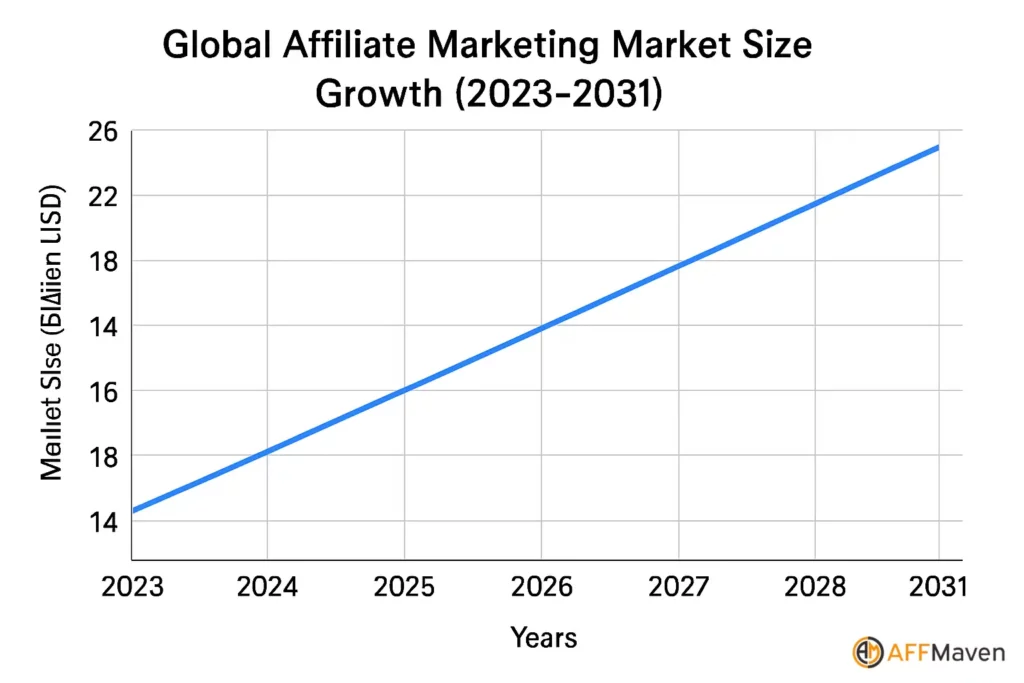
The affiliate marketing industry has experienced remarkable expansion across all major markets. Current data reveals significant growth patterns that indicate sustained momentum through the remainder of this decade.
Global affiliate marketing will cross a valuation of $20 billion in 2026, with industry analysts projecting continued growth at an annual rate of 8-10%.
The market expansion is driven by increased ecommerce adoption, mobile commerce growth, and the integration of advanced tracking technologies.
| Year | Global Market Size | U.S. Market Size | Annual Growth Rate |
|---|---|---|---|
| 2023 | $15.7 billion | $9.56 billion | 9.2% |
| 2024 | $18.5 billion | $10.8 billion | 10.1% |
| 2025 | $20.2 billion | $12.0 billion | 11.9% |
| 2031 (projected) | $31.7 billion | $18.2 billion | 8.5% average |
The industry’s projected growth of 65% between 2023 and 2028 positions affiliate marketing as one of the fastest-growing segments in digital advertising. This expansion is particularly notable in emerging markets, where affiliate program adoption is accelerating rapidly.
US Affiliate Marketing Spending and Performance
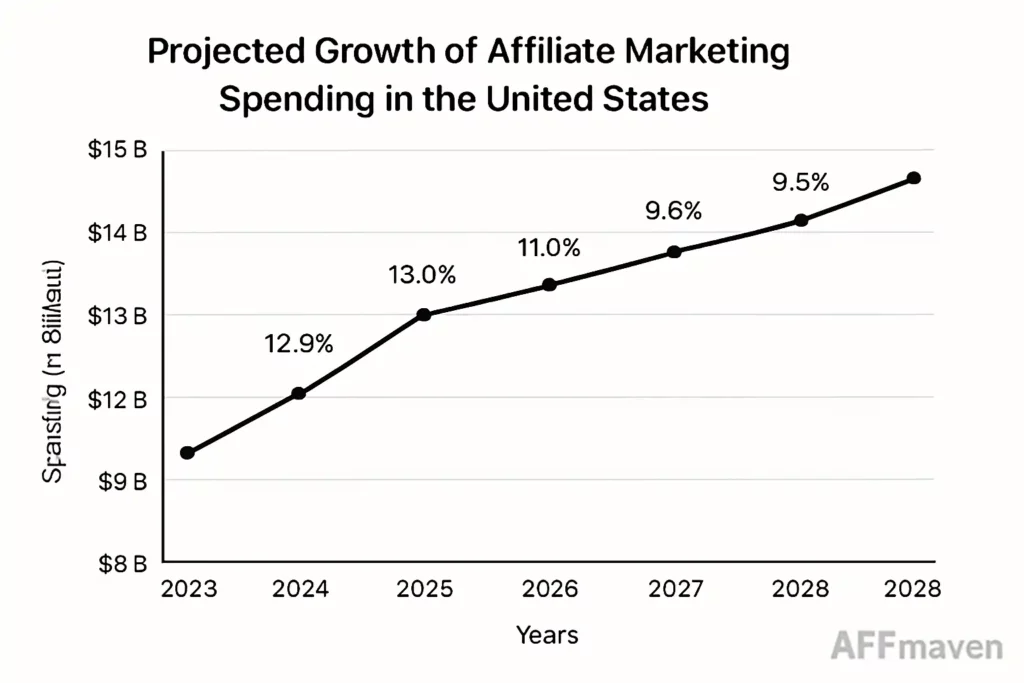
In the United States, affiliate marketing is a primary channel for customer acquisition, with spending consistently on the rise. Businesses see a notable return on their investment, solidifying its place in marketing budgets.
Here is a look at the projected growth of affiliate marketing spending in the United States:
| Year | U.S. Affiliate Marketing Spending (in billions) | Year-Over-Year Growth |
|---|---|---|
| 2023 | $9.56 | 13.7% |
| 2024 | $10.72 | 12.2% |
| 2025 | $11.99 | 11.9% |
| 2026 | $13.20 | 10.1% |
| 2027 | $14.47 | 9.6% |
| 2028 | $15.80 | 9.2% |
Affiliate Marketing Demographics and Participation

Understanding who participates in affiliate marketing programs provides valuable insights into the industry’s maturation and professional development. The demographic data reveals a shift toward more experienced, strategic marketers.
Brand participation in affiliate marketing has reached saturation levels, with 81% of brands now operating some form of affiliate program. This widespread adoption reflects the proven effectiveness of performance-based advertising in generating measurable returns.
Key demographic insights include:
The average affiliate marketer income shows significant variation based on experience level. Newcomers typically earn $1,000-$5,000 monthly, while experienced marketers with 10+ years generate $44,000+ per month on average.
Affiliate Network Market Leadership and Competition
Affiliate networks connect brands with affiliates, facilitating program management and payouts. Market leaders dominate, but niche players continue to grow.
Affiliate platforms vary by industry focus, service offerings, and tracking technologies, shaping affiliate strategies.
Market Share Distribution
The affiliate network marketplace shows clear market leaders with significant concentration among top performers:
| Network | Market Share | Active Affiliates | Key Strengths |
|---|---|---|---|
| Amazon Associates | 46.21-48.23% | 900,000+ | Product diversity, brand trust |
| Rakuten Affiliate | 7.12% | 150,000+ | Global reach, enterprise focus |
| CJ Affiliate | 7.07% | Not specified | Advanced tracking, premium brands |
| ShareASale | Significant presence | 700,000+ | User-friendly interface, diverse merchants |
| Awin | Growing market share | 1,000,000+ | International presence, technology focus |
Network Publisher Participation
Total affiliate network participation reaches impressive numbers across major platforms:
Revenue Models and Commission Structures
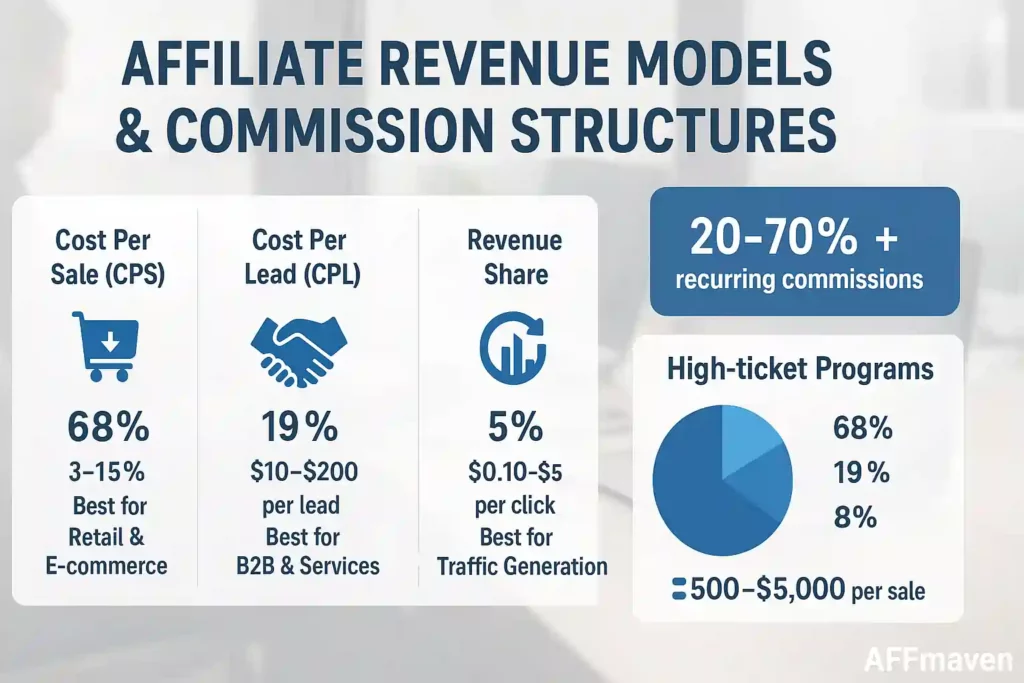
Affiliate commission structures continue to evolve as brands seek to optimize their cost per acquisition while maintaining attractive incentives for top-performing affiliates.
The most common revenue models reflect the industry’s focus on performance-based outcomes. Cost Per Sale (CPS) remains the dominant model, preferred by 68% of affiliate programs due to its direct correlation with actual revenue generation.
| Revenue Model | Usage Percentage | Average Commission Rate | Best For |
|---|---|---|---|
| Cost Per Sale (CPS) | 68% | 3-15% | Ecommerce, Retail |
| Cost Per Lead (CPL) | 19% | $10-$200 per lead | B2B, Services |
| Cost Per Click (CPC) | 8% | $0.10-$5.00 per click | Traffic Generation |
| Revenue Share | 5% | 20-50% ongoing | SaaS, Subscriptions |
SaaS affiliate programs offer particularly attractive terms, with many providing 20-70% commission rates on initial sales plus ongoing revenue sharing. This model has attracted many affiliates to focus on software and digital service promotions.
High-ticket affiliate programs in niches like education, business software, and financial services typically offer commissions ranging from $500-$5,000 per sale, though conversion rates are correspondingly lower.
Mobile Affiliate Marketing Trends
Mobile devices now generate the majority of affiliate marketing traffic, fundamentally changing how campaigns are designed and optimized. Understanding mobile-specific trends is crucial for success.
Mobile Traffic Statistics:
Platform-Specific Mobile Performance:
Platform Performance and Channel Effectiveness
Social media platforms and traditional marketing channels show varying levels of effectiveness for affiliate campaign performance. Understanding these differences helps marketers allocate resources more efficiently.
Facebook continues to dominate affiliate traffic generation, with 75% of affiliate marketers using the platform for campaign promotion. The platform’s sophisticated targeting capabilities and large user base make it particularly effective for product promotion and affiliate link sharing.
Platform performance breakdown reveals:
Email marketing remains highly effective, with affiliate email campaigns achieving average open rates of 22% and click-through rates of 3.8%, significantly higher than general email marketing benchmarks.
Artificial Intelligence Impact on Affiliate Marketing

AI in affiliate marketing has become a game-changing factor in 2026, with most successful affiliates adopting some form of artificial intelligence to optimize their campaigns and content creation.
The integration of AI tools has changed how affiliates approach content creation, campaign optimization, and audience targeting. Machine learning algorithms now help predict consumer behavior and optimize affiliate links placement for maximum conversion potential.
Current AI adoption rates in affiliate marketing show:
Predictive analytics powered by AI help affiliates identify trending products before they become mainstream, giving early adopters significant competitive advantages. These tools analyze consumer behavior patterns, seasonal trends, and market dynamics to inform strategic decisions.
Automated campaign management through AI reduces the manual workload while improving performance metrics. Smart bidding algorithms and real-time optimization ensure affiliate marketing campaigns maintain optimal performance across multiple channels simultaneously.
Content Creator Revenue and Publisher Statistics
Content creators increasingly depend on affiliate commissions as a primary or supplementary income source across various platforms and content types.
Consumer Behavior and Purchase Patterns
Online shopping behavior continues to evolve, with affiliate marketing influence playing an increasingly important role in consumer decision-making processes.
Mobile commerce now accounts for more than 50% of affiliate-driven traffic, reflecting broader shifts in consumer shopping habits. This mobile-first approach requires affiliates to optimize their content and landing pages for smaller screens and touch-based browsing.
Consumer engagement patterns show:
Cross-device tracking has become essential as consumers frequently begin their research on mobile devices but complete purchases on desktop computers. Advanced attribution models help ensure affiliates receive proper credit for their role in the customer journey.
Customer retention rates for affiliate-acquired customers average 68%, compared to 45% for traditional advertising channels, demonstrating the quality of traffic generated through affiliate marketing.
Regional Market Analysis and Growth Patterns
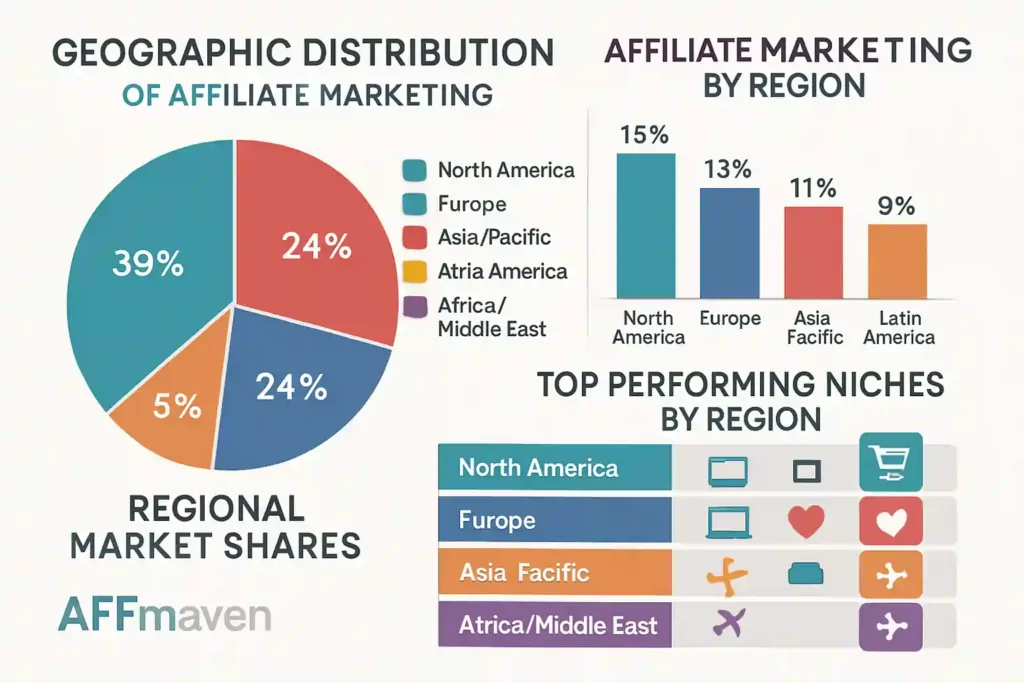
Geographic distribution of affiliate marketing activity reveals significant regional variations in both participation rates and market maturity levels.
North America maintains its position as the largest affiliate marketing market, accounting for approximately 40% of global spending. The region’s mature ecommerce infrastructure and high digital advertising adoption support continued growth in affiliate activities.
| Region | Market Share | Average Commission Rates | Top Performing Niches |
|---|---|---|---|
| North America | 40% | 8-12% | Technology, Fashion, Health |
| Europe | 28% | 6-10% | Travel, Finance, Education |
| Asia-Pacific | 22% | 10-15% | Electronics, Gaming, Beauty |
| Latin America | 6% | 12-18% | Fashion, Home, Fitness |
| Africa/Middle East | 4% | 15-25% | Mobile, Education, Finance |
Emerging markets in Asia-Pacific and Latin America show the highest growth rates, with affiliate program adoption increasing by 25-30% annually in these regions. Lower competition and higher commission rates make these markets particularly attractive for new affiliates.
European markets face unique challenges due to GDPR compliance requirements, but also benefit from high consumer trust in affiliate recommendations and strong conversion rates averaging 4.2% across major markets.
Affiliate Earnings and High-Paying Niches
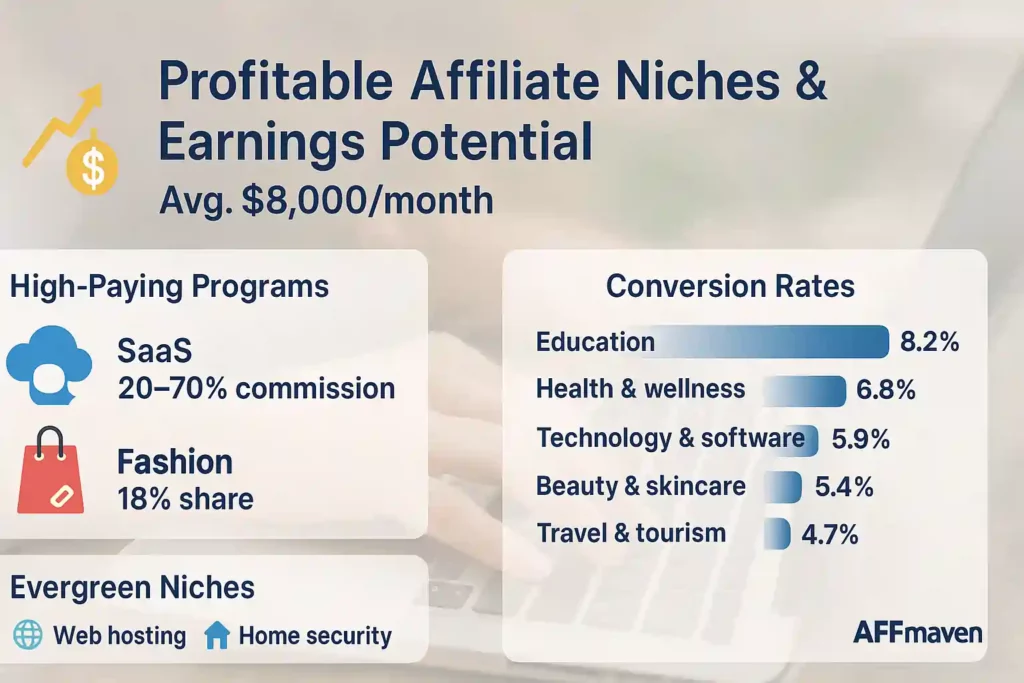
Affiliate income can vary greatly depending on the niche, commission structure, and the affiliate’s influence. Certain sectors offer much higher earning potential, particularly those with recurring revenue models.
High-Performing Niches:
Evergreen niches like web hosting, home security, and investing continue to be profitable due to consistent consumer demand.
Return on Investment and Performance Metrics
Understanding the financial returns and key performance indicators helps businesses evaluate affiliate marketing effectiveness and optimize their investment strategies.
- Average ROI across all affiliate marketing campaigns reaches $15 for every $1 spent.
- Top-performing campaigns achieve ROI rates of 25:1 or higher.
- Email affiliate marketing generates the highest ROI at $42 for every $1 spent.
- Social media affiliates produce $8-$12 ROI per dollar invested.
- Content marketing affiliates achieve $16-$20 ROI through organic traffic.
- Click-through rates (CTR) average 2.1% across all affiliate campaigns.
- Conversion rates range from 1.8% to 8.2% depending on industry vertical.
- Average order value (AOV) through affiliate channels is $89.
- Customer lifetime value (CLV) for affiliate-acquired customers averages $287.
- Attribution window effectiveness peaks at 30 days for most industries.
Ecommerce Integration and Sales Impact
Affiliate marketing plays a crucial role in the broader ecommerce ecosystem, driving significant portions of online sales and customer acquisitions across various product categories.
Ecommerce sales contribution statistics demonstrate affiliate marketing’s substantial impact on digital commerce.
Affiliate marketing drives 16% of all ecommerce sales in the United States, making it one of the four most significant sources of online orders.
Transaction volume generated through affiliate channels reaches impressive levels annually:
Revenue attribution patterns among businesses show varying degrees of dependency on affiliate marketing:
Mobile commerce impact significantly affects affiliate marketing success. 62.22% of web traffic comes from mobile devices, compared to 36.06% from desktop and 1.72% from tablets. This shift necessitates mobile-optimized affiliate strategies and responsive design implementations.

Stay Updated with Us
Conclusion
Affiliate marketing continues proving its value as performance-based advertising reaches new heights. With the industry projected to hit $31.7 billion by 2031, commission-based marketing shows no signs of slowing down.
These affiliate program numbers reveal a channel that delivers consistent results across all business sizes. Revenue sharing models create win-win scenarios, while CPA marketing ensures advertisers only pay for actual results. Influencer partnerships and content marketing drive the majority of successful campaigns today.
The data speaks clearly about affiliate marketing’s role in modern ecommerce strategy. But with 78% of marketers now using AI tools and conversion optimization becoming more sophisticated, one question remains: Are you ready to capitalize on these trends?
🚀 Get Exclusive Affiliate Marketing Secrets🚀
Discover the strategies, tools, and tactics used by the top 1% of affiliate earners!

Join 69,572+ Affiliates already leveling up their game
Affiliate Disclosure: This post may contain some affiliate links, which means we may receive a commission if you purchase something that we recommend at no additional cost for you (none whatsoever!)