If you’ve been in the affiliate game as long as we have (since the “Wild West” days of 2012), you know that disappearing budgets and shady networks are just part of the territory. But here is the deal: in 2026, the stakes are higher.
Global ad fraud losses are projected to hit over $41.4 billion this year alone. That is money vanishing into thin air—or rather, into the pockets of bad actors.
At AffMaven, we’ve seen “premium” networks vanish overnight with six figures of affiliate payouts. We have also seen “super affiliates” get banned for pumping bot traffic that would make a cyborg blush.
But there is a massive confusion in our industry. People use the words “Scam” and “Fraud” like they are the same thing. They are not. Confusing them is a rookie mistake that will cost you money.
Scam vs. Fraud: The Core Difference
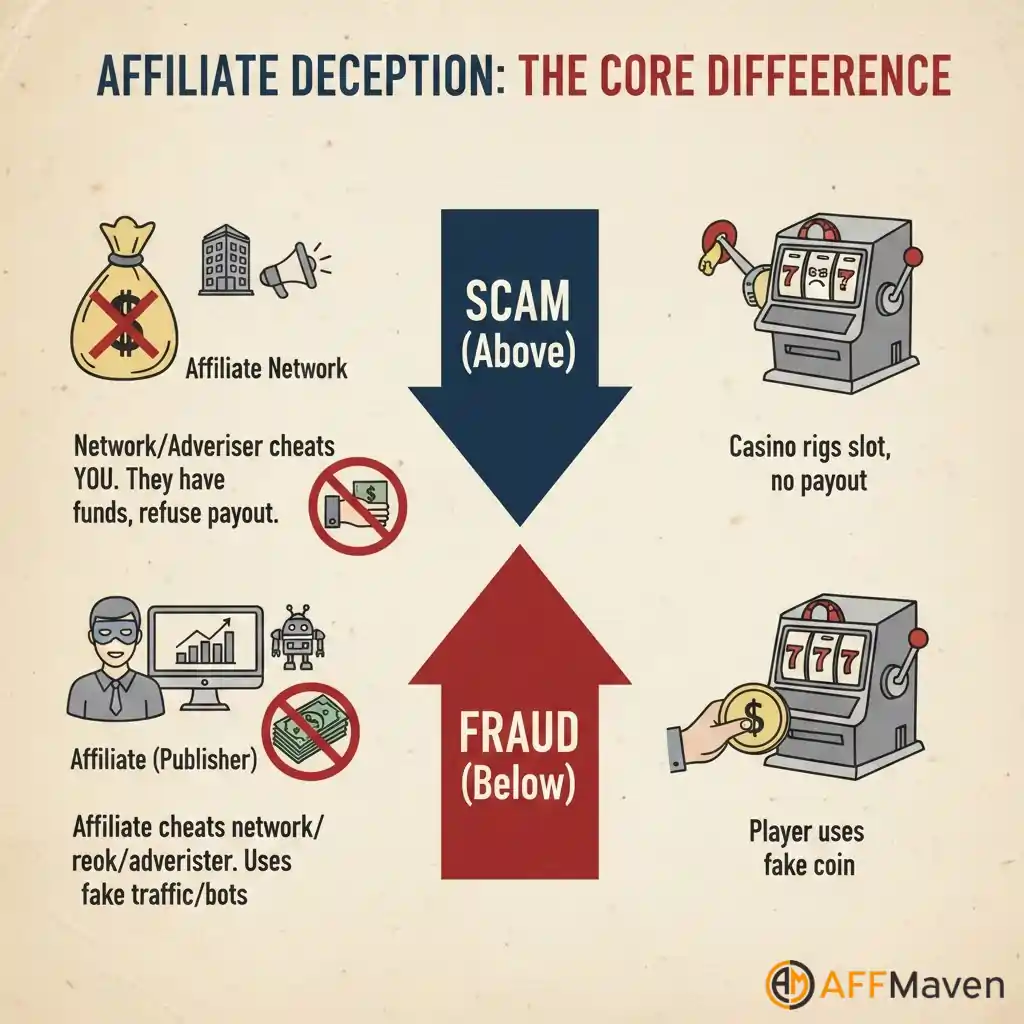
In simple terms: Scam comes from above. Fraud comes from below.
Think of it this way: If a casino rigs the slot machine so it never pays out, that is a Scam. If a player uses a fake coin to play the machine, that is Fraud.
Anatomy of a Scam: How Networks Steal
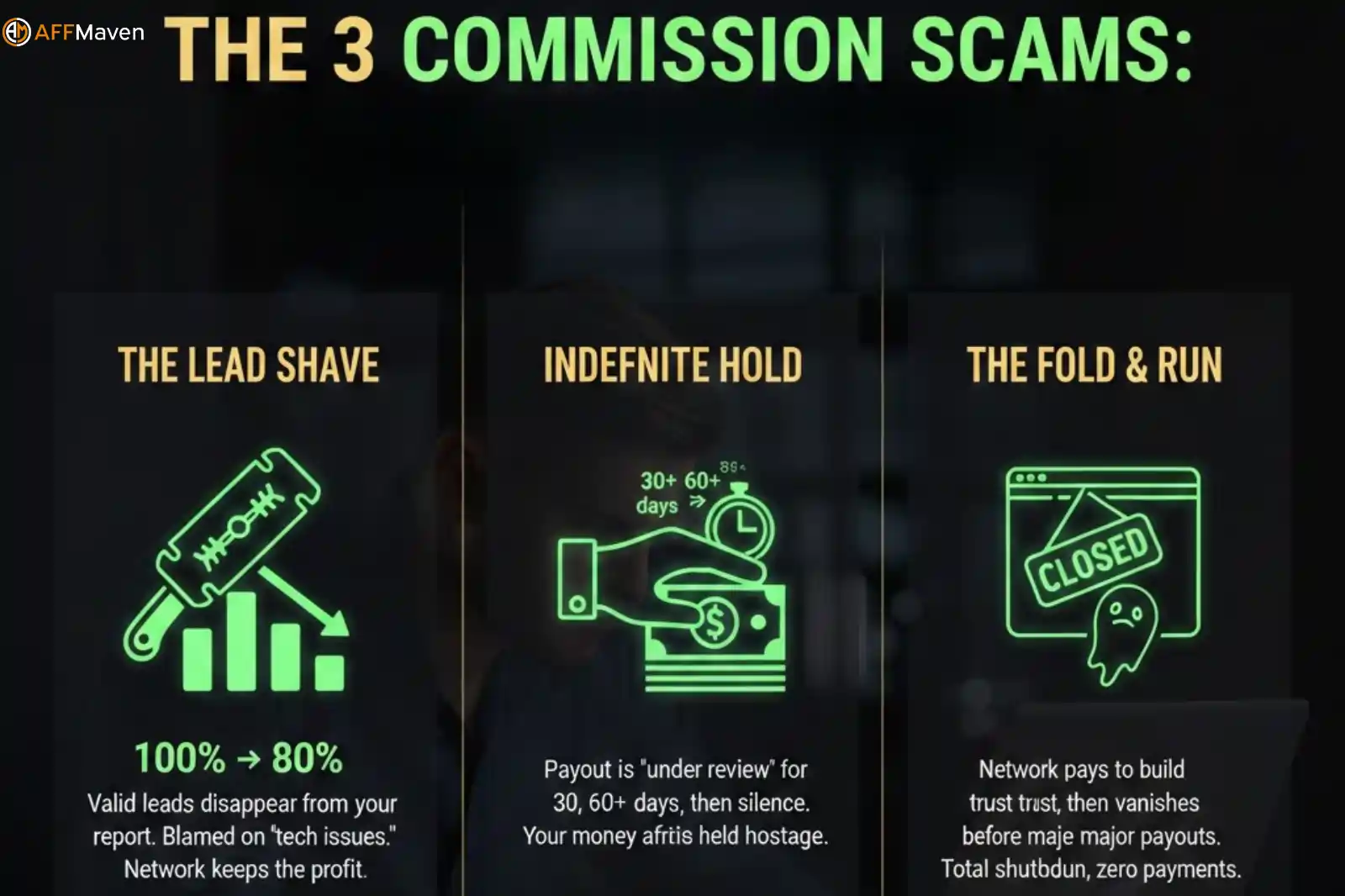
A scam happens when you do the work, but you don’t get paid. The network or advertiser has the power. They control the stats and the wallet. Here is how they steal your money.
The “Shave” (Shaving Leads)
“Shaving” is the silent killer of affiliate profits. This is when a network scrubs valid leads from your report. You might send 100 perfect leads. The network tells you that you only sent 80. They pocket the money for the other 20.
They often blame “technical issues” or “advertiser rejection.” But in reality, they are just increasing their profit margin. It is hard to prove, which makes it the perfect crime.
The Indefinite “Quality Check”
This is a classic move. You request a payout. The manager tells you your traffic is “under review” for quality. They say it will take 30 days. Then 60 days. Then they stop answering your messages.
They hold your money hostage. Eventually, they might ban your account for “suspicious activity” just to keep your balance.
The Exit Scam (Fold and Run)
This is the nightmare scenario. A network promises high payouts. They pay on time for a few months to build trust. Then, right before a big payment cycle (like Black Friday or Christmas), they disappear. The website goes offline. The Skype accounts go dead. The owners vanish with millions in unpaid commissions.
Affiliate Fraud: The Dark Arts of Traffic

Fraud is when an affiliate tricks the system. They want to get paid for fake results. This cost the industry over $84 billion in 2023 alone.
Bot Traffic and Click Farms
Bad affiliates use software (bots) to visit websites and click ads. Some even use “click farms”—rows of hundreds of phones connected to racks, all clicking ads automatically.
Advertisers pay for these clicks, but they get zero sales. It is pure theft.
Cookie Stuffing
This is a sneaky tactic. An affiliate loads a tiny, invisible image on a popular website. When a user visits that site, the image drops an affiliate cookie on their browser.
If that user later buys something from Amazon or eBay, the cheater gets a commission—even though they did nothing to help the sale.
Incentivized Traffic
Some offers say “No Incent.” This means you cannot pay people to sign up. Fraudsters ignore this. They go to sites where people do tasks for pennies. They pay users $0.50 to sign up for a $5.00 CPA offer. The advertiser gets a useless lead who only wanted the $0.50.
Also Read 👉 How to Stop Affiliate Fraud From Stealing Your Profits
Scam vs. Fraud: The Comparison Matrix
Here is how to spot the difference instantly.
| Feature | SCAM (The Network) | FRAUD (The Affiliate) |
|---|---|---|
| Initiator | Advertiser / CPA Network / Broker | Arbitrageur / Webmaster / Bot Farm |
| Goal | Withhold earned money | Steal unearned budget |
| Method | Shaving, banning accounts, ghosting | Bot traffic, cookie stuffing, click injection |
| Status | Appears authorized but is theft | Unauthorized and malicious |
| Victim | The Webmaster (You) | The Advertiser & The Network |
| Red Flag | “Payment delayed for audit” | CTR is suspiciously high (e.g., 5%+) |
| Action | Stop traffic, document chats, public shaming | Block sub-IDs, install anti-fraud tools |
The Cold Hard Facts: 2026 Market Data
You might think this is a small problem. It is not. The data for 2026 is alarming. If you are not watching your stats, you are losing money.
Here is what the industry looks like right now:

Almost 1 in 5 clicks you pay for might be fake. If you are buying traffic without a tracker or anti-fraud tool, you are essentially burning 20% of your budget before you even start.
Legal Landscape: Playing by the Rules
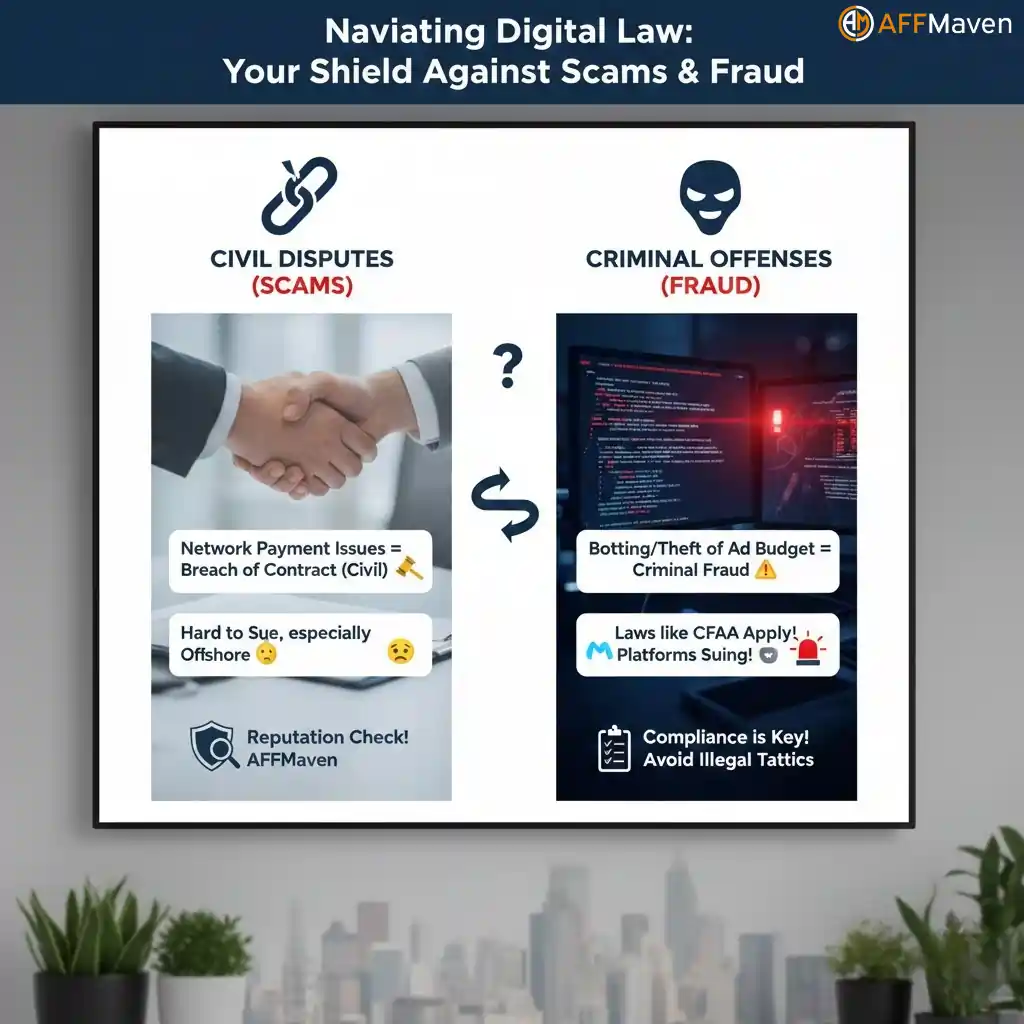
Understanding the law helps you assess risk.
Scams are often civil disputes. When a network doesn’t pay, it is usually a “breach of contract.” Unless you can prove criminal intent (which is hard), your only recourse is a lawsuit. For offshore networks, this is practically impossible.
Fraud is often criminal. Deliberately using bots to steal ad budget is theft. Laws like the CFAA (Computer Fraud and Abuse Act) in the US can apply. In 2026, platforms like Meta are aggressively suing for fraudulent ads.
The AFFMaven Verdict
After watching this industry evolve for over a decade, here is the brutal truth:
Assume everyone is guilty until paid. Treat every new network as a potential scam risk. Treat every new traffic source as a potential bot farm.
In 2026, the winner isn’t just the best marketer. It’s the one who keeps the most of what they earn. Stay sharp. Play fair. And get paid.
Stay Updated with Us
🚀 Get Exclusive Affiliate Marketing Secrets🚀
Discover the strategies, tools, and tactics used by the top 1% of affiliate earners!

Join 69,572+ Affiliates already leveling up their game
Affiliate Disclosure: This post may contain some affiliate links, which means we may receive a commission if you purchase something that we recommend at no additional cost for you (none whatsoever!)